Showing posts with label Research Tools. Show all posts

Monday, April 17, 2017

Madness Monday - Revisiting the Sharps and the Durdens

Hey everybody, this is actually a brand new post, as opposed to a previously posted post.

I actually did a little research this weekend. Yay for me!

When I first returned to my research, way back in 2009, I was hoping that by tracing some of my grandmother's cousins, I could crack the case of my mysterious great grandmother, also know as Fannie of the many names.

Two of those cousins that I was trying to trace were Pvt. Wheeler Sharp and Willie Claude Durden. I wrote about Pvt. Wheeler "Bubba" Sharp here and here and I wrote about the Durdens here.

My last activity on Bubba was to contact the funeral home that provided the services for his son, Avie, who died in November of 2010. 2 of Avie's siblings were still living and my hope was that my letter and info to the funeral home would be forwarded to them. I waited and waited and waited for a response but never received one.

I eventually forgot about both Bubba and Claude until this past week, when I received an email from Shelly, who informed me that her boyfriend was Bubba's great grandson and that she had come across documentation that listed Bubba's mother as Cora Durden.

I wrote her back and told her what I had on Pvt. Sharp and that his SS-5 application showed Cora Wheeler as his mother but I remembered that cousin Claude Durden's mother was named Cora, too. I also pointed out that for a brief period the two family's lived next door to each other. I also mentioned, that although Cousin Claude's SS-5 application stated that his mother was Cora Clemmons, my gut was telling me that these 3 Coras were all one in the same.

Glad I listened to my gut. It took me awhile to confirm what my gut was telling me, and even though the transcription was in error, there it was, the marriage of Warren Durden and Cora Sharp. (Cora's name had been transcribed as Cova)


So, Pvt. Wheeler was Cousin Claude's older brother, which explains the two families living next door to each other after they migrated from Walton County, GA to my home county (Cleveland) in NC. So from what I've been able to gather so far. Cora and Wheeler's Father, Ive, probably married sometime around 1890. by the 1900 census Cora was a widow with 4 children, one of which was "Bubba". She married Warren Durden in 1904 and had 2 more children, one of which was Willie Claude.

Since both of these men were related to my grandmother, I immediately assumed (rightly or wrongly) that more than likely the connection to my grandmother was on their mother's line. Unfortunately for me, just as quick as I had that bit of success in putting the brothers together, the door shut right back.

I had always wondered what happened to Cora after Warren Durden died in 1932. I've searched every record I could think of in NC and it was like she went pouf. No death certificates,  no marriages, nothing. I don't know why I didn't think of this earlier but it appears that Cora may have actually gone back home to GA, as I found a death certificate for a Cora Durden in Walton County, GA that appears to be my Cora. Unfortunately, the informant did not know her parents names. What's with all these mysterious women on my grandmother's side of the family.


Of course, there could also be the possibility that the men are related on their father's lines but for now, I'll just concentrate on Cora.
........
Sources

  1. Ancesrty.com. Georgia, Marriage Records From Select Counties, 1828-1978 [database on-line]. Provo, UT, USA: Ancestry.com Operations, Inc., 2013.
  2. "Georgia Deaths, 1928-1940," database with images, FamilySearch (https://familysearch.org/ark:/61903/1:1:QJX9-H2MY : 4 April 2016), Cora Lee Durden, 24 Mar 1938; citing Good Hope, Walton, Georgia, United States, Georgia Archives, Morrow; FHL microfilm .


Sunday, October 13, 2013

2013 AAHGS Conference - Saturday, October 12, 2013

Another fun-filled, jam packed day here at the AAHGS conference.

I begin the day by working in a bit of much needed exercise.

After having a filling lunch of salmon on orzo, it was off to session II, Unlocking Our Southern Mosaic: Examining a Family's Life Near It's Slavery Origins, by Dwight Fryer. Mr. Fryer's work as a minister was evident in the way he told the story of his family's origins in Grand Junction, TN.

I have to be honest, when Mr. Fryer began his presentation, I thought he was referring to Grand Junction, CO, a locale where I resided for a few years during my adult life. It was a little confusing at first, because his description of Grand Junction of course wasn't matching up with the Grand Junction I knew. After realizing there was another Grand Junction, the presentation began to make sense.

Wonderful points of interest from Mr. Fryer's presentation include:

  • A Union Army Contraband Camp was formed in Grand Junction, TN.
  • Western Tennessee, where Grand Junction is located, had the same culture and politics as Mississippi. In fact, Mr. Fryer referred to it as Tennessipi.
For the next session (III), I attended Understanding African American Genealogical Patterns as Remnants of Slave Culture: Demographics, Family Dynamics and Religious Practices. The presenters were Rev. Dr. Richard Gardiner and Ceteria Richey.

Ceteria, realized like many African-American families that she knew more about her mother's side of the family that she did her father's side of the family. She also realized that her mother's family was a strongly matriarchal family.

Using the principles of Cognitive Therapy, Ceteria tries to understands the whys of her family? Cognitive Therapy seeks the patient overcome difficulties by  identifying and changing dysfunctional thinking, behavior, and emotional responses. These principles can be applied to society as a whole.

The roots of the matrifocal society in the African-American community finds it's roots in slavery. During slavery, African-American women's value was their womb. Slavery was perpetuated because the status of any children born into slavery was through the mother. When women were sold it was always due to her potential increase to the owner. Women and their young children were often sold together.

Mean while, men were often used as studs, in other words, humans were breed like cattle and horses. Often if the men and women refused each other, they might be whipped.

In my younger days, I use to argue against this notion, that 100+ years removed from slavery that the effects of slavery were still manifest. But, as I've gotten older and looked through the more mature eyes, it seems that families that came through slavery intact do not seem to have as many of the problems as those who were ripped apart.

For the final session of the day, I attended Shelly Murphy's (aka familytreegirl on Twitter) Hitting the Genealogy Brick Walls & Challenges: The Search for Information about Joseph Brand Davis.

Shelly hates using the term Brick Walls because she believes there are no such thing as Brick Walls only Challenges. 

Highlights from Shelly's presentation are as follows:
  • All research should focus on asking questions
  • Know what laws were in place during a particular time frame.
  • Records generate other records
The day was wrapped up with dinner, a little entertainment by two young local talents, and the awards ceremony. Sandwiched between the entertainment and the awards presentation, we listened to the keynote speaker, Thomas Cain talk about the Nashville connection to the music industry. Can you say Little Richard.

And with that it's a wrap folks as my time here at the 2013 AAHGS conference comes to a close. Mom and I will be heading home in the AM. I've had a wonderful time meeting new people, finally meeting those I've known online for a few years now, and just being able to get away for a few days.

Hopefully, this is finally the beginning of me returning to the research and blogging. I hear the ancestors telling me to get back with it. 

Friday, October 11, 2013

2013 AAHGS Conference - Friday, October 11, 2013

Today was the first full day of speakers at the 2013 AAHGS Conference.

I took in two of the four sessions (Session I and Session IV).

For Session I, which was from 10:30 to 11:30, I attended Toni Carrier's presentation on Port Royal: The Birthplace of Freedom in the Old South. I've known Toni for several years via now the online Genealogy Community. So, not only did I learn a lot about Port Royal but I also got an opportunity to finally meet Toni in person by attending this session.

The events that occurred in Port Royal helped to set the stage for emancipation elsewhere. Some of the interesting facts that I learned from Toni's presentation were

  • 9 of the 16 largest slave holders were in SC
  • More than 5,000 men from SC served in the USCT after the fall of Port Royal 
  • Sherman was forced to call on northern charities to helped provide subsistence to the former slaves
  • Many of the Freedman formed land cooperatives in order to purchase land. Many descendants of the freedmen still live on the land .
To find out more about Toni's work, please be sure to check out Low Country Africana. 

Lunch was from 11:45 - 1:15 and the keynote speaker was Chris Haley, nephew of Alex Haley, author of Roots. The topic of Chris' speech was Our Ancestors Gave Us the Rights; Our Nation Gives Us the Potential.

Neither my mother nor I attended the 2nd and 3rd sessions for today, which were from 1:30 - 3:45 . Instead, we ventured to the Nashville National Cemetery in order that I could see my Uncle's grave in person. When my Uncle Toussaint passed, I was not able to attend his funeral. I also recently acquired some information on my uncle's life and the struggles that he and my aunt had to go through while pursuing careers in education. Lastly, since my aunt and uncle never had any children and there is no other known family in Tennessee,  it was my own personal way of acknowledging that my uncle would not be forgotten.

After visiting my uncle's grave, I took my mother for a little shopping at the mall. Whenever we travel out of state, mom always wants to check out the stores, even if they are they same ones we have back in North Carolina, because she always looking for a new pair of shoes.

After returning to the conference, mom and I attended separate presentations during Session IV, which was form 4:00 to 5:00. I attended Researching Abandoned Cemeteries by Jo Ann Williams McClellan. Ms. McClellan discussed how she went about trying to find Negro Cemeteries in Maury County, TN.

Ms. McClellan began with the approach of determining the location of Negro schools and churches. This was accomplished by checking records, interviewing local historians and community elders, and contacting local funeral home directors.

Via these methods, names of cemeteries were determined but not always their exact location. In order to better determine the location of the cemeteries Ms. McClellan used the Internet, especially the Geographic Names and Information System (GNIS).

Ms. McClellan's research project was later expanded to include death records because the majority of graves did not contain headstones. More information about Ms. McClellan's project can be found in Gone But Not Forgotten African American Cemeteries and 1908 - 1930 Death Records of Maury County, Tennessee (ISBN 0981995152 9780981995151).

Dinner for tonight was a wonderful buffet which included potato salad, collard greens and potatoes, sweet potato casserole, pulled pork, ribs, and apple cobbler.

After dinner, we heard the final speaker for today, Dr. Learotha Williams, who did a presentation of Slave Grandchildren Remember. Dr. Williams is documenting the remembrances of grandchildren whose grandparents were born into slavery.

And so the day comes to a close. Looking toward another fun filled day tomorrow. 


Friday, March 16, 2012

Are you Ready for the 1940 census?

For me the answer is a resounding NO. But hey, I've got a full 17 days to get up to speed.

In tracing my ancestors, I'm not one that really needs the 1940 census. Both of my parents had already arrived into this world by the 1930 census. So while I'm looking forward to the release of the 1940 census, it's not that critical to my research, and this could explain why I'm not ready. Well that and the fact that I've been busy with other things like what will probably be a year long house decluttering project.

Even though the 1940 census is not critical to my research efforts, there are a few things I hope to accomplish.  I'm hopeful that my Grand Uncle, Felton Pierce, will resurface, because I will not rest until I put together the rest of his life. It will also be fun to see the folks as tweens.

So, how does one prepare for the release of a new census when they only have 17 days. To be honest, I don't have a clue or a game plan, so I'll be winging it. Hopefully, I will have time within the next 17 days to post how I'm preparing myself for the release of the census.

So are you ready for the release of the 1940 census and what do you hope to accomplish?

Friday, January 27, 2012

Free Offline Genealogy Tools - Week 4 of Abundant Genealogy

Week 4 - For which free offline tools are you most grateful? How did you find this tool and how has it benefited your genealogy? Describe to others how to access this tool and spread the genealogy love.


This genealogy challenge runs from Sunday, January 22, 2012 through Saturday, January 28, 2012.


My favorite free off-line genealogy tool has to be the Carolina Room at the Main Branch of the Charlotte Mecklenburg Library. While my hectic schedule has not allowed me to use this local resource as much as I would like and hoped to, I still must tout it.

When I first discovered this wonderful local resource, I was pleasantly surprised that they actually have many resources that pertain to other states. Ironically, for my research focus, there actually seem to be more resources for my Georgia ancestral counties than my North Carolina ancestral county.

The Carolina Room is not just for genealogy but history as a hold and therefore, contains many other valuable resources. The following list provides a general idea of some of the resources available in the Carolina Room:


  • Newspapers
  • Newspaper Clippings
  • Periodicals, which includes over 400 titles
  • Census Records
  • Pamphlets, Brochures, Ephemera
  • Maps
To find out more about the resources available within the Carolina Room's collections, just visit the Charlotte Mecklenburg Library site and do a search for the Carolina Room.

*****
This is the fourth challenge in 52 Weeks of Abundant Genealogy, a weekly challenge developed by Amy Coffin of The We Tree Genealogy Blog. The weekly challenges are posted by Thomas MacEntee at Geneabloggers.


Friday, January 20, 2012

Free Online Genealogy Tools

Week 3 - Free Online Genealogy  Tools: Free online genealogy tools are like gifts from above. Which ones are you most thankful for? How has it helped your family history experience?


This challenge runs from Sunday, January 15, 2012 through Saturday, January 21, 2012.


There are several free online genealogy tools but two of my favorites are definitely Family Search and Georgia Virtual Vault.

Family Search - I think I might have mentioned this a few times but it seems that within the past year, I've probably been able to find more information via Family Search than with Ancestry.

Some information is a duplication of information found on Ancestry, such as census records, but other information is not.

You can browse by location or name. There are also some wonderful learning resources which are provided through courses or wikis. In addition, there are also discussion forums.

Georgia Virtual Vault - If you have roots in Georgia, this site is a must stop destination in your online research.

The Indexed Death certificates (1919 - 1927) and the Non-Indexed Death Certificates (1928 - 1930) will save a researcher both time and money. There are also marriage records, although these are not available for every county or every year within a given county.

The Vanishing Georgia Collection provides many wonderful pictures that just may contain an ancestor.

The site contains many other wonderful resources. You just have to poke around and I'm sure you will enjoy it as much as I have.

......

This is the third challenge in 52 Weeks of Abundant Genealogy, a weekly challenge developed by Amy Coffin of The We Tree Genealogy Blog. The Weekly challenges are posted by Thomas MacEntee at Geneabloggers.


Sunday, December 18, 2011

2011 Genealogy Christmas Wish List

I just realized that Genealogy Santa was pretty good to me last year. While I didn't get the Flip Camcorder or Wayfarers in Walton County, I did manage to get everything else on my 2010 Genealogy Wish List.

Of course I have to admit that I didn't actually get the Kia Soul at Christmas time but about 6 months later when the Suzuki Forenza decided that it had had enough.

So what's on my Genealogy Christmas Wish List for 2011.

Camcorder - Since Cisco decided to exist the Flip Video business, I've decided that I would prefer a regular camcorder. As I noted last year, the size of regular camcorders has come down tremendously. As stated last year, I think a small camcorder is perfect for those times when a you need a bit more than a still shot. I just have to determine the one that is right for me and my needs so that I can tell Santa.

Wayfarers in Walton County - I still would like a copy of this. Maybe this will be the year Santa can find a copy to place under my tree.

Nook - No particular reason I need this other than I'm a gadget freak. I'm sure genealogist need a reader for something.

So there you have it. No big ticket items like last year, so I'm hoping Santa can be accommodating.


Tuesday, November 1, 2011

31 Days of Genealogy - 10 Minutes at a Time - Days 26-31

This posts wraps up the 31 Days of Genealogy from Lisa Lee of Got Genealogy?. The daily challenges were a way to get us working on our genealogy everyday during the month of October, which is Family History Month. Most of the activities required a minimal amount of time, usually 10 minutes  or less.


The activies for Days 27 - 31 are as follows:


Days 27) Create a Google Alert - These allow you to monitor the web for interesting information. I've created a google alert for my name, my business name, and for one particular branch of my family (e.g. "Crawley genealogy").  Google.com/alerts is free, and you only need to create a gmail account (also free).  You can control how often Google notifies you (weekly, daily, immediately) and the types of items (books, video, news, etc).

Days 28) Join a Remote Genealogical or Historical Society - No matter where your ancestor lived, there's probably a genealogical or historical society at that faraway location.  Those remote societies often publish a periodic newsletter, complete with transcriptions, helpful information about resources, and in many cases, they'll do free (or almost-free) look-ups for members.  I use this feature often, with my Ontario Genealogical Society memberships, since I'm thousands of miles away in California, since I'm a long-distance member, they'll do a quick look-up for me, saving me time and considerable expense.

Days 29) Try Mocavo.com - Not one of my favorite sites, but many people love it.  It's touted as a genealogy search engine, in my opinion, it still has a ways to go before I'll use it on a regular basis.  That said, based on your own ancestry, you may find the Mocavo search results useful. Good thing it's free.


Days 30) Find a local genealogy class and take it - No matter where you live, you can probably find a local genealogy class taught within an hour's drive of your home.  In many cases, these classes are presented at a public library, at a church or other public venue, and many of the classes are free.  Even if the class is outside your general interest area, you can still learn something.  One of the most interesting classes I took was a Chinese genealogy class, in San Francisco.  I had never heard the term "Paper sons" before, and wasn't aware of the Chinese Exclusion Act and how it impacted generations of Chinese in the U.S. and those desiring to come to the U.S.  It gave me a new appreciation of the difficulties of genealogy, and I've used pointers from this class again and again over the years.

Days 31) Create an Ancestor Display - Using a foam board, create a display for one branch of your family, complete with photos, reduced-size photocopies of documents, maps, recipes, migration patterns, interesting quotes, etc.  The goal is to create something you can share with your relatives during the holidays.  Yes, we know that many of them aren't interested in genealogy, but by creating an attractive, interesting display, you can post it on a wall, easel, stand it up on a table, etc., so, before dinner is served, your relatives will have a chance to examine the information, learn something new, and even the most recalcitrant relative may be inspired to actually open up and share some stories of information. 


Day 27: This was something I had already done. I've set up Google Alerts for my name as well as for ancestral surnames.


Day 28: I'm a member of the East Georgia Genealogical Society, which covers all the known counties in which my maternal ancestors resided. I'm also a member of Martin County (NC) Genealogical Society which covers the geographic area of my paternal ancestors.


Day 29: I think I've tried the Macavo site before and didn't particularly care for it. That being said, I did try it again. I'm still not sure about the site. Unfortunately, I can't quite put my finger one what I don't like about the site. I'll put it in my arsenal of tools but not sure if it will be the near the top of the list of things I use.


Day 30: By doing a quick search of my local library's event calendar, I learned that there is a one day class next month, November 12, 2011, at the Mint Hill branch of our library. The title of the class is Find Your Ancestor & Learn About Yourself.


Day 31: This is a great idea. I've done similar things in the past like create a family tree for my my mother and my aunts as Christmas presents. Last night, I really didn't have time to create the foam board display. For me, this is one of those activities that would have taken longer than 10 minutes, so hopefully, after I finish up a few craft projects, I can create this. 


Monday, October 24, 2011

31 Days of Genealogy - 10 Minutes at a Time - Days 19 - 25

During the month of October, which is Family History Month, I'm participating in Lisa Lee of Got Genealogy? 31 Days of Genealogy. The daily challenges are designed as a way to get us working on our genealogy each day during the month of October. Most of the challenges only require 10 minutes to do.


The challenges for Days 19 - 25 are as follows:


Days 19) Start a family Health History, using your pedigree chart.  Note the causes of death of as many people on the chart as possible, looking to identify any trends that may be passed down generation to generation.

Days 20) Write a quick 5-min story about one of your ancestors.  Send it, along with a photo, to a local genealogical society for their newsletter, or even to your local newspaper, as they're always looking for fresh content.

Days 21) Look for online obituaries for your relatives.  Do an Internet search for the city where they died, to determine the name of the local papers, then look for an online obituary archive.

Days 22) Create a blog for one branch of your family.  If you already have a blog, create a new one.  Blogs are free on sites like Blogger.com, Wordpress.com,Weebly.com, Blog.com, etc.

Days 23) Backup your family file to Dropbox.com, which is a FREE cloud storage site.  You can upload files, documents, videos, music, etc., and access the information from any computer, Mac or PC.  You need to backup your family files at least once per month.

Days 24) Create a "Passwords File" which includes all the Internet passwords for the various accounts you have online.  This needs to be either placed with your final instructions (for use after you die), or instructions where the file resides on your computer.  Without passwords, your heirs will not be able to access any family files/information you've posted online.

Days 25) Make plans to attend at least one regional or national genealogical conference next year.  It's never too early to start planning.  Groups such as the FGS, APG, Southern California Genealogical Society (SCGS), NGS, International Black Genealogical Summit, RootsTech, Ontario Genealogical Society (Canada), Ohio Genealogical Society, etc., are just the tip of the iceberg.  Check out their Web sites and start making plans to participate in one or more of these.


Day 19:  While doing my research, I've often noted, mentally, what my ancestors died from but I've never taken the time to do a formal genogram. Since for me, this activity feels like it may take a bit longer than 10, I plan to work on it later in the week when I have more time.

Day 20: What a great idea! This ties in with Lisa challenge from Day 3, which was to work on your genealogy gifts by writing the life history of one  ancestor. Since I'm already working on my paternal great grandfather, Peter T. Everett, for the Christmas gift, I've decided to also use him in submitting an article to the Martin County, NC Genealogical Society.

Day 21: This is something I do at least once a week trying to find obituaries for ancestors as well as more recent relatives. Usually, I find myself doing this on Tuesdays when I'm trying to find something to post for Tombstone Tuesday.

Day 22: Currently, I have two blogs documenting my research / search for my ancestors. The first is of course this blog, Georgia Black Crackers, which documents my search for my maternal ancestors, and the other is Conversations with my Ancestors, which documents my search for my paternal ancestors.

Day 23: I think I've heard of Dropbox.com but have never bothered to check it out. After listening to the video on Dropbox, I think this is exactly what I need. Currently, I have genealogy information on my desk top and lap top as well as a couple of flash drives. Many times I've driven myself mad going back and forth between the laptop and desktop to retrieve files.

Day 24: I've created a password file for my financial information and actually have some of my genealogy passwords within that file. However, thanks to this exercise, I created a totally separate file for all my genealogy passwords.

Day 25: Since it will be in my home state, one conference that I'm planning to attend in 2012 is the 33rd Annual National Conference of the Afro-American Historical & Genealogical Society, Oct 4-7. I would also like to attend at least one month meeting of the East Georgia Genealogical Society as well as the Martin County, NC Genealogical Society.


Sunday, October 23, 2011

31 Days of Genealogy - 10 Minutes at a Time - Days 15 - 18

After finally getting caught up on all the daily challenges from Lisa Lee of Got Genealogy?, I quickly fell behind, again. The daily challenges are a way to work on your genealogy each day during the month of October. Since the challenges require a minimal amount of time, Lisa touts they can be done in 10 minutes, even if you get behind, you can catch up quickly.


The challenges for Days 15 - 18 are as follows:


Day 15) Explore Genealogy Blog Finder  blogfinder.genealogue.com.  Their collection of topics is wide-ranging and covers such items as famous folks, Jewish, genetic genealogy, podcasts, obituaries, and oh, so much more.  Find something new and exciting, or add your own to the mix.


Day 16) Learn how easy it is to print your entire family pedigree on one huge piece of paper.  On OnePage Genealogyroots.cs.byu.edu/pedigree/ you can download their software (Mac or PC) and use it to create the chart. Once you've tweaked it, copy the PDF file onto a thumb drive and take it (or email it) to your local copy center to have it printed on a huge poster.  OnePage Genealogy is free and is easy to use.
Days 17) Enroll in an online genealogy course with the National Institute for Genealogical Studies. Whether you want to go for your PLCGS certificate, or just brush up on one or two courses, these classes are high calibre and very affordable.  Classes are conducted online, where you can interact with your instructor via phone or online.  Check out their catalog at: www.genealogicalstudies.com

Days 18) Download a free trial of a different genealogy software program.  You may love the one you've been using all this time, but each program has its features and benefits, as well as shortcomings.  Mac users are lucky in that they can run Mac programs or PC programs, using PC emulation software such as Bootcamp, VMWare Fusion (my favorite) or Parallels.
Check out this site, for a side-by-side comparison of Mac and PC genealogy software programs:
http://genealogy-software-review.toptenreviews.com/ppc-index.html?cmpid=74103


Day 15: I went to the Genealogy Blog Finder site. One of the first things I did was check to see if my blogs were listed there. This blog, Georgia Black Crackers, was listed among the blogs, but my other blog, Conversations With My Ancestors, was not. So, the first thing I did was submit a request to add Conversations with My Ancestors to the list.

I also checked out other blogs on the site. In my eyes, I see the Genealogy Blog Finder as another resource in keeping up with the various blogs. I also use Google Reader and see the two complimenting each other.

Day 16: This is a great idea and something I've always envisioned doing this for a family reunion. So, I've started to work on and tweak this, so that I can hopefully present it at future family reunion(s).

Day 17:  After several attempts, I was unable to access the National Institute of Genealogical Studies website. Hopefully, later today, I will be able to access it.

Day 18: I currently use Roots Magic. I also have Family Tree Maker, which was my first genealogy software program. Even though I already have 2 software programs, I decided to download the free version of Legacy Software. I've heard several of my fellow bloggers talk about Legacy, so I decided to check it out. Will report back later on my experience with the software.


Friday, October 14, 2011

31 Days of Genealogy - 10 Minutes at a Time - Days 13-14

I've been participating in Lisa Lee's, Got Genealogy?, 31 Days of Genealogy. These are projects to get us working on our genealogy each and every day during the month of October, which is Family History Month. Most of the projects can be done within 10 minutes.

The projects for Day 13 and 14 are as follows:


Day 13) Transcribe or re-transcribe a written document.  Have an old military, land, immigration or other record?  Take the time to transcribe the entire document, or, re-transcribe one you already transcribed years ago.  

Day 14) Order a microfilm from the Mormon Family History Library ONLINE. It's a new feature, at www.familysearch.org/films, and the films will be sent to your local Family History Center (FHC), but it makes it much easier to order the films, using a credit card or you Paypal account.

Day 13: I've not gotten this project accomplished, yet. My goal is to work on it this weekend.


Day 14: I recently discovered that microfilms can be ordered online. I've had 3 sitting in my cart for a while now and needed this prompt to go ahead and order them. I'm so happy that the ability to order microfilms has finally been put online. The Family History Center that I go to isn't on any of my usual routes, I often find myself driving there just to order. It will be so much nicer to be able to order on line and just go when the microfilm finally arrives. It may not add up to a huge time savings but as they say, every little bit helps.


Monday, October 10, 2011

31 Days of Genealogy - Days 8-10

For the month of October, which is Family History Month, I've been working through the daily activities that Lisa Lee of Got Genealogy?, has devised to get us working on our Genealogy. Lisa touts that these activities can be done in 10 minutes.

Due to getting slightly behind on reading my e-mails, it was a few days into the month before I realized that Lisa was doing this. As a result, I've been trying to catch up by doing several of the activities each day.

The activities for Days 8-10 are as follows:

DAY 8) County Courthouse Day
 It may be Saturday, and even though your county courthouse is closed, the internet is open 24/7.  Spend a few minutes looking to see what online databases and resources your county courthouse has available.  Pick a county where one of your ancestor lived, and do the following searches:
Buncombe County, NC register of deeds  (customize this search with YOUR county)
… registrar or deeds
… recorder
… court recorder
… courthouse or court house
… clerk

Each county is a separate entity.  Some offer oodles of online information, some offer none, and they constantly change.  Even if you've looked before, look again.  If you find something useful, be sure to bookmark it.

DAY 9) Public Library Day
 Just like county courthouses, public libraries may or may not offer information useful to genealogists.  One neat trick I've found is that if I search for public libraries in the county where my ancestor, the search results will include any county public libraries found along with all of the cities within the county that also have their own public libraries.  Try search for, say, "wayne county michigan public library" and you'll get a list of libraries in Detroit, Westland, Garden City, and others, along with a map of where each is located.
You can also go to PublicLibraries.com, which gives an alphabetical list within each state, which may be helpful.
Some public libraries offer free research assistance, the Richland County, SC public library will do free lookups of obituaries and will scan the images and email them to you (for free), the Indiana State Library has free genealogical databases online including marriages, newspaper indexes, military records, etc., and you don't have to be a member to access this information.

State, county and local libraries are a great start, but be sure to look for college and university libraries, private, genealogical, historical society and ethnic libraries.  For example, a search for "african american libraries" or "jewish library association" will provide dozens of links of such libraries all over the U.S. There's a ton of information out there – go find it!

Day 10) Join a Genealogical or Historical Society
Even if you're not a professional genealogist, if you want to become one, the Association of Professional Genealogists (APG) is a wonderful place to start (apgen.org). You can join for as little as $35/year, which entitles you to the quarterly journal (APG Quarterly), or for $65/year you'll get full voting rights, discounts to genealogical conferences, will be listed on the APG's Web site and can attend APG meetings.  One of the hallmarks of the APG is their commitment to high research standards, to ensure that all APG members conform to their Code of Ethics.

If your ancestor lived in a faraway county, there's probably a genealogical or historical society there, and you should consider joining.  Most provide a quarterly journal of local information, and being a member, I've found the ones to which I belong more than happy to help me with look-ups and tips for trip planning… even a free place to stay when I came to town on a research trip.  You know how the old saying goes, "You can never join too many genealogical societies."


Day 8: I research primarily in Georgia (maternal lines) and North Carolina (paternal lines). For the counties that I research in Georgia, I don't find much online for the individual counties but I do make full use of Georgia Virtual Vault, which has a considerable amount of information online. In North Carolina, my county of focus has primarily been Martin County. A lot of old deeds and even more recent deeds can be found at the Martin County Register of Deeds Remote Access Site.


Day 9: While I've not done it often, I have employed local libraries in the areas that I research. Most often I write, but I've also visited them if I'm in the area. I appreciate Lisa providing the site to find the listing of Public Libraries. Until now, I did not know of this site.


Day 10: I've already joined a few genealogical societies. I've joined the local ones where my ancestors lived, East Georgia Genealogical Society (EGGS) and Martin County (NC) Genealogical Society. I've also joined the North Carolina Genealogical Society. Depending on funds, I'm also planning to join the Afro-American Historical and Genealogical Society (AAHGS) and the National Genealogical Society (NGS).


And with this post, I'm finally up to date on the daily activities. So far, I've really enjoyed the activities. Thank you Lisa for coming up with this idea.

Sunday, October 9, 2011

31 Days of Genealogy - Days 4-7

For Family History Month, Lisa Lee of Got Genealogy? has devised a series of fun activities and projects to get us working on our genealogy every day during the month of October. Most of the activities will only require 10 minutes of your time.


Today, I worked on the activities for Days 4-7 in an effort to get almost caught up on the daily activities.


The activities for Days 4-7 are as follows:


DAY 4) Consanguinity Loops
Take two minutes to view my "Consanguinity Loops" video and get a better understanding of how two people are related, so that you can explain it at your next family reunion.  View Video
DAY 5) Facebook Groups
If you're not already on Facebook, you're missing out on an incredible resource of information.  Find relatives, discover new information about your family, find photos, etc.  JOIN FACEBOOK.COM TODAY.

If you're already on Facebook, search for new groups to join and join them.  Do a search for:
GENEALOGY
FAMILY HISTORY
ANCESTRY
DNA

You get the idea.  Once a member of these groups, you can ask questions, post answers, share interesting Web sites, etc.  The more you reach out, the more information you'll find.

DAY 6) Order a Social Security Application ONLINE
If you haven't already tried it, this new, convenient service, is fast, secure and reliable, and costs less, because you don't have to pay for postage, paper and an envelope.  Plus, the desired SS application arrives faster than a mail request. $27 for each request.  BOOKMARK THIS URL: https://secure.ssa.gov/apps9/eFOIA-FEWeb/internet/main.jsp

DAY 7) Subscribe to Dick Eastman's Genealogy Newsletter

blog.eogn.com/eastmans_online_genealogy/)blog.eogn.com/eastmans_online_genealogy/
Dick Eastman has been around since before the beginning of recorded time, and when it comes to computers, genealogy and all things technology, he's your guy.  His award-winning newsletter offers free and premium  ("Plus", only $20/year) versions, and both are jam packed with interesting and useful information.  Sure, you could probably spend countless hours trying to find half the stuff you'll find in just one of his online newsletters, but he's the expert at finding information and making difficult topics easy to understand.  Eastman's newsletter is a must-have for all genealogists.  Subscribe today.


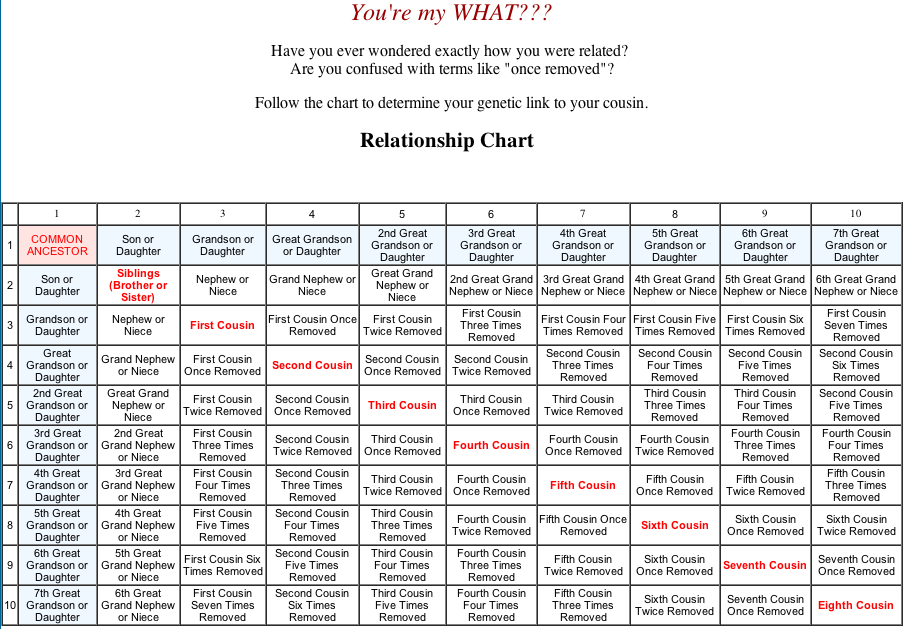
Day 4: Depending on the cousin chart used, I tend to have no problems understanding the chart but trying to explain it to a person who use happens to want someone to explain once removed and twice removed, etc. can be a bit daunting.


Lisa's Consanguinity Loops approach is easy to understand. So, the next time I attempt to explain cousins to someone, I will use Lisa's loops approach and see if eliminates the glazed over eyes.


Day 5: I've been on Facebook almost from the moment that I renewed my research back in 2009. Although I was hesitant in joining Facebook, I'm glad that I did. I've discovered and gotten to know some of the descendants of my great Uncle, Will Hosch, via Facebook.


There are also some great genealogy groups. One that I joined recently is DNA Tested African Descendants. Other groups include East Georgia Genealogical Society, Inc (EGGS), Georgia Genealogy Network, and Haplogroup L3.


Day 6: I've ordered several Social Security Applications online. When compared against request that I've mailed in, I do get the application faster.


Day 7: I've been a subscriber to the free version of Dick Eastman's newsletter for awhile. I decided to go ahead and upgrade to the Plus version because often times I've found myself wanting more.


Saturday, October 8, 2011

Genealogy Christmas Gifts and 31 Days of Genealogy - 10 Minutes at a Time

In honor of October being Family History Month, Lisa Lee of Got Genealogy? has devised some great ideas and activities that will have us working on our genealogy every day during the month of October. The activities can be done in as little as 10 minutes.

Since I'm a little behind on the daily activities, I'm hoping to get caught up by doing 2 - 3, maybe more, of the activities each day.

The third activity (Day 3) that Lisa has us doing is

Start Working on Your Genealogy Holiday Gifts
No excuse, you have plenty of time to write the life history of ONE of your ancestors, cite it (sources are a MUST), format it, pretty-it-up, print it and get it gift wrapped in time for the holiday season in December.  You don't have to write the story of your entire family … just pick one or two ancestors, and tell their story.  If you keep it in historical context, it will make your story more compelling and those who receive it will be more inclined to keep it around for future generations.


What a great idea! Lisa even gives an example from her own family. 


The thing I like about this project is that for those of us who one day plan to pen the history of our families, it's a great starting point to begin that process.


For this project, I've selected two ancestors, one from my maternal side, great grandfather Cornelius Pierce, and one from my paternal side, great grandfather Peter Everett.


Since I've already done a PowerPoint presentation for Grandpa Cornelius, I'm hoping that one will come together quickly.


31 Days of Genealogy - 10 Minutes at a Time - Day 2

October is Family History Month and Lisa Lee, Got Genealogy?, has
devised a clever way for us to squeeze a little genealogy in every day this month.

Since I missed reading this earlier this week, I'm a little behind on the daily activities and am trying to get caught up. So, you might see a few posts from me today as I try to catch up.


The exercise / activity for Day 2 is as follows:


Join StumbleUpon.com


This FREE Web site makes it easy to find interesting Web pages, photos and videos that you probably wouldn't find on your own.  You can create your preference of "interests," and StumbleUpon will go out and find other Web sites, photos and videos that include that topic.  In addition, if you login using your FaceBook credentials, whenever any of your FB friends "likes" a particular Web site in StumbleUpon, you'll be notified.  StumbleUpon makes the Web a much smaller place, and increases the likelihood that you'll find new information you probably wouldn't have found on your own.


I've seen some of my genealogy friends using StumbleUpon but never really understood it or knew exactly what it was until doing this activity.


I set up an account on StumbleUpon and selected my interests. I then searched on some of my interests. Although not genealogy related, I came across an interesting recipe posted in one of the blogs at dailytarheel.com for Peanut Butter Pretzel Bites. By the way, I am a Tarheel.


And although I've seen this before, the first thing that came up when I did a search of genealogy was a cousin chart which had been posted at Los Cuatro Ojos


Monday, December 6, 2010

Amanuensis Monday – Research Trip, Day 1

After the 2010 Atlanta Family History Expo, I went on my first research trip. Day 1 of the research trip was spent in Monroe, Walton County, GA and Day 2 of the trip was spent in Greensboro, Greene County, GA.

The main purpose of this research trip was to acquire the probate records of my maternal Great Grandfather, Cornelius Pierce. Last year, I wrote the Walton County, Georgia Probate court to inquire if there were probate records for my great grandfather. They informed me that there were records but that due to the age and fragileness of the documents that they could not make copies. The documents would need to be transcribed or I could take a picture of them. I did both. My mother, who accompanied me to the Family History Expo and on the research trip, was a great help during the transcribing. She read and I wrote.

My great grand father died intestate, without a will. Therefore the records regarding his estate were found in the Minutes of the Walton County Ordinary Court and not the Wills and Estate Records. Because of this, it took me awhile to locate the proceedings.

Proceedings regarding my great grandfather’s estate took place over the course of the September and October 1911 terms of the court. (My great grandfather died May 14, 1910.) The following are the proceedings petitioning the court to sell the property. At the time of my great grandfather's death, he was in the process of purchasing this property.

Walton County Court of Ordinary, Oct 2nd Term 1911


To the Ordinary of said County


The petition of Jas. E. Carlton, adim of the Estate of Cornelius Pierce deceased, showeth that the Estate of said deceased in part A track of land in Town district it being part of the James Tanner Place. Containing 62 ¾ acres more or less bounded on the north by Alex Norris, east by Lon Pierce, south by Green Hawk, and west by G. A. Gibson and Mrs. Allcorn. Said Cornelius Pierce, at the time of his death, held bond for title to said land with part purchase money paid and the Bank of Monroe held deed. And said Bank of Monroe consents to the sale, provided the balance of the purchase money is paid by the Admin or all of the sale of the land and that for the purpose of paying the debt of said estate. It is necessary to see the said land. Therefore, petitioner seeks an order directing citation issue and be published as the law requires and if no good cause be showed to the contrary your petitioner be granted leave to sale said land.


J. E. Carlton Administrator


Walton County Court of Ordinary, Sept Term, 1911


Upon reading the foregoing petition, it is ordered that citation issue intervene and published as the law requires.


E. C. Arnold, Ordinary


Walton County Court of Ordinary, Oct. Term 1911


The written petition of James E. Carlton as admin of the estate of Cornelius Pierce, deceased, praying for leave to sell the land of said deceased having been duly filed and in appearing that notice of the same has been published as required by law that is necessary for the purpose of paying the debts of said estate that said land be sold and no objection being filed. Hereto it is ordered by the court that the said James E. Carlton he, and he is hereby granted leave to sell for the purpose of aforesaid, the following described land of said deceased all the track of land in town district in Walton County containing 62 ¾ acres more or less bound on the North by Alex Norris, east by Lon Pierce, south by Green Hawk and west by G. A. Gibson and Mrs. Allcorn.


The balance of the purchase money to be first paid to the Bank of Monroe, and the balance to be paid on other debts according to priority.


E. C. Almond, ondy


The underlined words were ones that mom and I had trouble making out.

Also, Lon Pierce, whose proprety was to the east, was my great grand uncle, great granddad's brother.


Wednesday, November 3, 2010

Review of Genealogical Goals for September / October 2010

While I still have several goals from September / October that need to be started on and / or completed, I actually managed to get a few things accomplished.

Goals I attained are as follows:

Research

  1. As I will be doing my first research trip this month to ancestral counties, I decided not to resubmit my request to RAOGK to obtain a transcription / photograph of my great grandfather's, Cornelius Pierce, probate records. One of my goals while on the research trip is to obtain this myself.
  2. I did order and receive microfilm through the Family History Center. Films ordered were: Index to records, 1790 - 1942, Greene County, GA and Original Wills, ca 1663 - 1978. Unfortunately, there was no apparent documentation to assist me in the continued search for my Pierce Ancestors prior to 1870.
Blogging / Writing
  1. While only 2 of the posts during the month of October actually had anything to do with my research, I did manage to get seven posts in during October.
Miscellaneous
  1. I did decide on a location to hold the reunion for the descendants of my grandfather, LC Hosch, my great Uncle, Will Hosch, and their cousin, Eli Hush. (Now I just need to put down a deposit and get to the real planning part).
  2. I did help my friend Leonard with the genealogy part of his grad school project. Given the short time frame in which I had to work and the fact that I didn't have a lot to go off of, I think we got a lot accomplished. He at least now has names of some great grandparents and all of his grandparents.


Monday, May 31, 2010

Madness Monday

Grandpa Jasper and Grandma Jane Pierce (Part IV)


I haven’t talked about the hunt for my 2nd great grandparents, Jasper and Jane Pierce, in awhile. The reason being at this point, there has been nothing to report.

If you will recall, in my last post on Grandpa Jasper and Grandma Jane, I had decided to try knocking on a few doors in White Plains via snail mail. I had planned to contact White Plains Baptist Church, Second Baptist Church, and Mrs. Mamie Hillman (Greene County African –American Cultural Museum and Resource Center).

  1. White Plains Baptist Church did check their records for my ancestors and notified me that they did not have any records for Grandpa Jasper or Grandma Jane.
  2. I’ve not heard from Mrs. Hillman or the Greene County African-American Cultural Museum and Resource Center. In trying to follow up on my snail mail correspondence, I’ve called and left messages at the telephone number listed on the Greene County African American Cultural Museum and Resource Center website as well as submitting a message via their website but as of yet, no response. I’m beginning to wonder if they are still in existence.
  3. I’ve not written Second Baptist Church, yet. I’m still trying to determine a mailing address for them. I’ve tried searching online but all I find listed is Kilpatrick St., not even a street number. Based my initial attempts to write other organizations in Greene County, I would suspect that they have a post office box. Anybody have any tips on determining this? Would one just call the post office there? Do post offices give out that type of information? I’ve tried calling Second Baptist but it’s usually during the week and there is of course no one there. They don’t have an answering system, so I can’t leave a message.

What now?

I will continue with my efforts to try to contact Mrs. Hillman and Second Baptist Church but I’m also using other avenues to try to determine my ancestors’ last slave owner.

A few weeks ago (May 8), I ventured back to the Family History Center and ordered more microfilm and now am waiting for them to come in. Microfilms ordered were:

  • White Plains Baptist Church Records, 1806 – 1921
    • This was ordered prior to hearing from White Plains Baptist Church. Even though the church stated they had no record of my 2nd great grandparents, I will still check. Perhaps they overlooked them.
  • Greene County GA Probate court Index to Records, 1790 – 1942
    • This was ordered in hopes of 1) determining if there was any information available for Jesse F. Pierce. In previous posts, I laid the groundwork for why I believe Jesse Pierce was my ancestors last slave owner. I realize that he was still living in 1870 and 1880; however, I’m hoping that a probate record, if available, may still reveal something about his relationship to my ancestors.
    • The other reason I ordered this is for the slim possibility that there may have been probate record(s) for Grandpa Jasper.
  • Greene County GA Deeds General Index v. A-B 1785 – 1889
    • I wasn’t sure whether I should order this one as it was unclear whether there were two volumes, labeled A and B, or whether it was surnames A-B. This was also ordered to try to gain information about Jesse F. Pierce and his property.
I’m also continuing to read up on the history of Greene County and am currently reading Tenants of the Almighty by Arthur F. Raper.


Sunday, March 21, 2010

Ancestral DNA and African-American Research

Part II  - Markers and Databases - Points to Consider

For me personally, the one thing, knowing exactly where your ancestors came from in Africa, that drives most African American researchers to do DNA, was never the driving force behind my doing DNA testing. What can I say I’ve always marched to the beat of my own drummer. For me, DNA testing was just another tool to use in in hopefully breaking down brick walls on this side of the Atlantic Ocean as well as reconnecting with lost kin.


These two thoughts, the need to know the exact locale from whence your Ancestors came and the need to break down brick walls and reconnect with lost kin are not incompatible with each other but may alter how you approach your research on ancestral DNA and which company to test with. In some cases, you may need to test with more than one company to obtain your goals.

Breaking through Brick Walls with DNA

When used as a tool to help break through brick walls, I think it’s important to know the size of the testing company’s database and to know how many STR markers and which ones are tested on a yDNA test and how many regions are tested on the mtDNA testing.

For yDNA testing, there are two types of markers, STR Markers and SNP markers. STR markers provide information on the personal Haplotype and SNP markers provide information on the Haplogroup. Put another way, STR markers provide information on your more recent ancestry and SNP markers, which mutate at a slower rate, provide information on your deep ancestry.

Understanding Markers

Depending on the testing company, you can order anywhere from a 9 to 91 STR marker test. A breakdown of the benefits of adding additional marker, beyond 12, to your testing is as follows:

  • 12 markers – Mainly used for anthropology projects, 12 marker testing does not provide enough information to provide conclusive results for genealogical purposes. An exact match at 12 markers means there is a 50% probability of having a common ancestor within the past 14 generations.

  • 25 markers – An exact match at 25 markers means there is a 50% chance that you share a common ancestor within the past 7 generations.

  • 37 markers – An exact match at 37 markers means there is a 50% chance that you share a common ancestor within the past 5 generations.

Some companies also offer further testing on the SNP markers providing what is known as subclade testing. This type of testing confirms the haplogroup that is predicted by STR (haplotype) marker testing.

mtDNA testing follows along a similar protocol with its coding regions. There are 3 coding regions, HVR1, HVR2, and HVR3. The majority of companies test two of the three coding regions; however, some only offer the HVR1 region. The information provided by adding additional tests regions is also similar to that of adding addition markers in yDNA testing.

I equate the adding of additional markers to starting with the ocean (12 markers) and narrowing it down to a single drop of water (67 markers). Do you need to add all the additional markers? No, but I think for genealogical purposes, you definitely need to go beyond just 12. Depending on the company you decide to test with, you can start with say 25 or 37 markers and later add more, if needed.

Database Size

If trying to break through a brick wall, the larger the database, the greater the possibility of your finding a possible DNA connection that may assist in helping that brick wall come tumbling down.

In this regard, it appears that Family Tree DNA has become the standard by which all others are judged as they have what seems to be the largest database. Please note that while I have tested with Family Tree DNA, this is not to say that you should or have to test with Family Tree DNA. This is simply provided as information for your research on Ancestral DNA.

Also, keep in mind that although DNA testing for genealogical purposes has been around for a few years now, it’s still somewhat of a novelty and is still somewhat expensive. The number of descendants of a given line researching is small and those that are doing DNA testing is probably even smaller. Therefore, while you may not get an exact match, you may still get a lead. Remember when it comes to breaking through the walls, it's a tool to be used in conjuntion with traditional research methods.

Determining Place of Origin through DNA

As determining place of origin on the continent of Africa is the driving force behind most African American researchers doing DNA testing, the size of the database and number of markers don’t play as significant a role as the type of database used by the testing company. Therefore, databases that are specifically geared toward Africa are very important.

The company most noted and probably the standard in this area is African Ancestry. If you have tested with another company, African Ancestry can take those results and interpret them to provide you with your present day African country of origin. In order to do this, your previous mtDNA results need to indicate that you are in Haplogroup L and your previous yDNA results need to indicate that you belong to Haplogroup A, B, or E. There is still a fee for this service but you do not have to submit another sample.

To Be Continued


Wednesday, March 17, 2010

Ancestral DNA and African-American Research

Part I – Understanding the Testing


In light of DNA playing a vital role in Emmitt Smith’s research in the recently aired episode of Who Do You Think You Are? and in the recent Faces of America series as well as pervious years airing of African American Lives, there has been increased interest in the African-American genealogy community on the use of DNA in your research. I don’t consider myself an expert on the subject of DNA or even ancestral DNA but it’s a subject matter within genealogy that I’m becoming increasingly passionate about. I will say that in part my interest could stem from the fact that in real life I’m part of the scientific community.

Before deciding to delve head first into ancestral DNA, the best advice is to 1) decide exactly what you hope to accomplish through DNA testing and 2) do as much research as possible on the subject so that you understand what can and cannot be accomplished through testing.

Types of DNA Testing

There are three basic types of testing with regard to ancestral DNA – yDNA, mtDNA, and autosomal (admixture).

yDNA

Ah, the Y Chromosome, it’s what makes males males. It’s passed from father to son each generation. Therefore, yDNA testing follows the direct male of an ancestor. Ex. your father, his father, his father, and so on. Visually, from a pedigree chart standpoint it follows the upper outside line. Only males can participate in yDNA testing.


mtDNA

The mitochondria is similar to the Y Chromosome with the exception that it is passed from the mother and it’s passed to both her male and female children. Which means both males and females can test the direct female lineage. mtDNA follows the path of your mother, her mother, her mother, and so on. In essence it follows along the lower most outside line of the pedigree chart.


mtDNA, due to its slow rate of mutation, can reveal more of your deep ancestry than it does closer relationships. Because of this, if two persons are an exact match in their mtDNA, it’s more than likely they shared a common ancestor.

Markers used in these two tests are used to determine Haplogroup, which is a grouping of individuals with the same genetic characteristics.

Keep in mind that unless you do testing on descendants of Ancestors that fall within the two outermost pedigree lines yDNA and mtDNA only captures about 2% of your ancestors. Ex. You would need a maternal uncle (one of your mother’s brothers) or one of his male children to do the testing for a maternal grandfather’s line.

Autosomal or Admixture Testing

Autosomal, also know as Admixture, Testing looks at the entire chromosome. To try to explain it in layman’s terms, you acquire half your chromosomal makeup from your father and the other half from your mother. It’s what makes each of us unique as what is passed on is unique for each child. It explains why full siblings can look alike or be as different as night and day.

This type of testing can give you an insight into some of the ancestry that lies between those two outermost pedigree lines. This is the testing that revealed to Emmitt Smith that he was 81% African. Autosomal testing won’t reveal what part was contributed by your mother and what came from your father.

To Be Continued