Showing posts with label Research Techniques. Show all posts

Monday, April 17, 2017

Madness Monday - Revisiting the Sharps and the Durdens

Hey everybody, this is actually a brand new post, as opposed to a previously posted post.

I actually did a little research this weekend. Yay for me!

When I first returned to my research, way back in 2009, I was hoping that by tracing some of my grandmother's cousins, I could crack the case of my mysterious great grandmother, also know as Fannie of the many names.

Two of those cousins that I was trying to trace were Pvt. Wheeler Sharp and Willie Claude Durden. I wrote about Pvt. Wheeler "Bubba" Sharp here and here and I wrote about the Durdens here.

My last activity on Bubba was to contact the funeral home that provided the services for his son, Avie, who died in November of 2010. 2 of Avie's siblings were still living and my hope was that my letter and info to the funeral home would be forwarded to them. I waited and waited and waited for a response but never received one.

I eventually forgot about both Bubba and Claude until this past week, when I received an email from Shelly, who informed me that her boyfriend was Bubba's great grandson and that she had come across documentation that listed Bubba's mother as Cora Durden.

I wrote her back and told her what I had on Pvt. Sharp and that his SS-5 application showed Cora Wheeler as his mother but I remembered that cousin Claude Durden's mother was named Cora, too. I also pointed out that for a brief period the two family's lived next door to each other. I also mentioned, that although Cousin Claude's SS-5 application stated that his mother was Cora Clemmons, my gut was telling me that these 3 Coras were all one in the same.

Glad I listened to my gut. It took me awhile to confirm what my gut was telling me, and even though the transcription was in error, there it was, the marriage of Warren Durden and Cora Sharp. (Cora's name had been transcribed as Cova)


So, Pvt. Wheeler was Cousin Claude's older brother, which explains the two families living next door to each other after they migrated from Walton County, GA to my home county (Cleveland) in NC. So from what I've been able to gather so far. Cora and Wheeler's Father, Ive, probably married sometime around 1890. by the 1900 census Cora was a widow with 4 children, one of which was "Bubba". She married Warren Durden in 1904 and had 2 more children, one of which was Willie Claude.

Since both of these men were related to my grandmother, I immediately assumed (rightly or wrongly) that more than likely the connection to my grandmother was on their mother's line. Unfortunately for me, just as quick as I had that bit of success in putting the brothers together, the door shut right back.

I had always wondered what happened to Cora after Warren Durden died in 1932. I've searched every record I could think of in NC and it was like she went pouf. No death certificates,  no marriages, nothing. I don't know why I didn't think of this earlier but it appears that Cora may have actually gone back home to GA, as I found a death certificate for a Cora Durden in Walton County, GA that appears to be my Cora. Unfortunately, the informant did not know her parents names. What's with all these mysterious women on my grandmother's side of the family.


Of course, there could also be the possibility that the men are related on their father's lines but for now, I'll just concentrate on Cora.
........
Sources

  1. Ancesrty.com. Georgia, Marriage Records From Select Counties, 1828-1978 [database on-line]. Provo, UT, USA: Ancestry.com Operations, Inc., 2013.
  2. "Georgia Deaths, 1928-1940," database with images, FamilySearch (https://familysearch.org/ark:/61903/1:1:QJX9-H2MY : 4 April 2016), Cora Lee Durden, 24 Mar 1938; citing Good Hope, Walton, Georgia, United States, Georgia Archives, Morrow; FHL microfilm .


Monday, October 13, 2014

Motivation Monday - October 2014

You know, even though I came no where close to meeting my September goals, and we are already almost half way through October, overall, I feel okay about my Genealogy activities during the month of September. I will say that most of those activities were performed on the paternal side of my family and you will be able to read about them, once I get them posted, on Conversations With My Ancestors.

So, the only goal that I seem to have gotten accomplished is I got back to blogging even if all my blogging was done using memes. But hey, it's a start to finally be seeming to get back into the groove.

Blogging wise, my goal was to do a minimum of 2 posts, not including Motivation Monday, for the month of September and I actually got 2 posts done. So, for the month of October, I hope to expand upon that and get three posts done, outside of Motivation Monday posts. But folks, I'm warning you ahead of time that most of these will probably be memes but like I said earlier, it's a way to begin again.

And yes, I still have those other two goals that have been hanging around for over a year and maybe I will get them done during the next month and a half.

In case you have forgot what they were.

In the area of Organization


  1. Get the Office / Craft room back in order
  2. Start organizing and making sure my citations are in order for my individual files
BTW, since we are already half way through October and I have tons on my plate, I'm giving myself until the end of November to get both of these accomplished, but hopefully, I will at least have made some progress by the end of October.

And in the area of actually getting back to the Research

  1. Read Slave Genealogy: A Research Guide with Case Studies by David H. Streets.
It occurred to me last month that I might have already read this but since I don't remember anything about it, I think even if I did already read it that it wouldn't hurt to go through it again.


Monday, September 1, 2014

Motivation Monday - September 2014 Goals

You know, since my father died in 2011, I've found myself on several occasions declaring I was ready to get back to my research. I can't guarantee that this time will be any different than those previous attempts to find my way back to the research and blogging but it feels like something is finally happening.

For one, while attending the funeral of my Aunt Dorothy this past weekend, I actually grabbed my camera and took it with me to photograph the tombstones of relatives that I knew were buried in this particular cemetery. So, I'm praying, hopping and taking that as a sign that I'm finally back.

So, let's try once again, to set a few monthly goals and yes most all of these are the same ones from back in April.

Blogging


  1. Write a minimum of two posts for the month.
Organization

  1.  Get Office / Craft Room back in order. Unlike back in April, I can at least move around in the room, and I have done some decluttering / organization since April but there is still a lot to do to get the room back in order. Goal Date: September 6, 2014
  2. Organize and make sure citations are in order for the individual folders that I have for myself and my parents. Goal Date: September 27, 2014

Reading

  1. Read Slave Genealogy: A Research Guide with Case Studies by David H. Streets. I purchased this book last year but can't remember if I ever got around to reading it. Since I'm back to this time period on most of my lines, I'm hoping that this reading will help me develop other approaches in finding my enslaved ancestors. Goal Date: September 20, 2014
I should add that I did get part of one goal from my April Goals accomplished, which was doing the Patriclan Test from African Ancestry on my Maternal Grandfather's line. I received the results this past week and will hopefully reveal them during the upcoming week.


Monday, October 21, 2013

Motivation Monday - The Remainder of 2013

Since it's been awhile since I've done any real research or blogging, I thought that I would finally get back into the swing of things by setting some goals for myself for the remainder of 2013.

So here goes,


  1. Finish the reorganization of the Office / Craft Room. Goal Date: December 14, 2013
    • Put shelving in the closet. Goal Date: October 31, 2013
    • Clean and Spiff up the File Cabinet. Yes this was a goal over 3 years ago. You can read about it here. Goal Date: November 23, 2013
    • Organize Bookcase. Goal Date: November 2, 2013
  2. Organize at least 5 Individual Folders (I keep folders for individuals as well as families) and make sure citations are up to snuff. The citations issues is the most important part of this goal. When I returned to the genealogy a few years ago, I didn't always do a real good job with my citations. Goal Date: November 28, 2013
  3. Write a minimum of one blog post per week. 
  4. Read Slave Ancestral Research: It's Something Else by Mary L. Jackson Fears. I've had this book on my wish list for awhile and finally decided to order it this past weekend through Half.com (my favorite book store along with Amazon). I'm at the 1870 Brick Wall on most of my lines. While I think, I've thought clearly in how to break through the wall, so far I've been unsuccessful. Therefore, I'm always looking for ideas that I've not thought of. Hopefully, this will get the wheels turning, again. Goal Date: November 28, 2013
  5. Write a research plan for determining / confirming the last owner of my 2nd great grandparents, Jasper and Jane Pierce. Goal Date: December 21, 2013
Since there were only 2 1/2 months left in the year, I didn't want to do a laundry list of things. I think these are attainable goals in the time frame that I've given myself to get them accomplished. I will get them done. I just need to keep telling myself that every day.


Sunday, October 13, 2013

2013 AAHGS Conference - Saturday, October 12, 2013

Another fun-filled, jam packed day here at the AAHGS conference.

I begin the day by working in a bit of much needed exercise.

After having a filling lunch of salmon on orzo, it was off to session II, Unlocking Our Southern Mosaic: Examining a Family's Life Near It's Slavery Origins, by Dwight Fryer. Mr. Fryer's work as a minister was evident in the way he told the story of his family's origins in Grand Junction, TN.

I have to be honest, when Mr. Fryer began his presentation, I thought he was referring to Grand Junction, CO, a locale where I resided for a few years during my adult life. It was a little confusing at first, because his description of Grand Junction of course wasn't matching up with the Grand Junction I knew. After realizing there was another Grand Junction, the presentation began to make sense.

Wonderful points of interest from Mr. Fryer's presentation include:

  • A Union Army Contraband Camp was formed in Grand Junction, TN.
  • Western Tennessee, where Grand Junction is located, had the same culture and politics as Mississippi. In fact, Mr. Fryer referred to it as Tennessipi.
For the next session (III), I attended Understanding African American Genealogical Patterns as Remnants of Slave Culture: Demographics, Family Dynamics and Religious Practices. The presenters were Rev. Dr. Richard Gardiner and Ceteria Richey.

Ceteria, realized like many African-American families that she knew more about her mother's side of the family that she did her father's side of the family. She also realized that her mother's family was a strongly matriarchal family.

Using the principles of Cognitive Therapy, Ceteria tries to understands the whys of her family? Cognitive Therapy seeks the patient overcome difficulties by  identifying and changing dysfunctional thinking, behavior, and emotional responses. These principles can be applied to society as a whole.

The roots of the matrifocal society in the African-American community finds it's roots in slavery. During slavery, African-American women's value was their womb. Slavery was perpetuated because the status of any children born into slavery was through the mother. When women were sold it was always due to her potential increase to the owner. Women and their young children were often sold together.

Mean while, men were often used as studs, in other words, humans were breed like cattle and horses. Often if the men and women refused each other, they might be whipped.

In my younger days, I use to argue against this notion, that 100+ years removed from slavery that the effects of slavery were still manifest. But, as I've gotten older and looked through the more mature eyes, it seems that families that came through slavery intact do not seem to have as many of the problems as those who were ripped apart.

For the final session of the day, I attended Shelly Murphy's (aka familytreegirl on Twitter) Hitting the Genealogy Brick Walls & Challenges: The Search for Information about Joseph Brand Davis.

Shelly hates using the term Brick Walls because she believes there are no such thing as Brick Walls only Challenges. 

Highlights from Shelly's presentation are as follows:
  • All research should focus on asking questions
  • Know what laws were in place during a particular time frame.
  • Records generate other records
The day was wrapped up with dinner, a little entertainment by two young local talents, and the awards ceremony. Sandwiched between the entertainment and the awards presentation, we listened to the keynote speaker, Thomas Cain talk about the Nashville connection to the music industry. Can you say Little Richard.

And with that it's a wrap folks as my time here at the 2013 AAHGS conference comes to a close. Mom and I will be heading home in the AM. I've had a wonderful time meeting new people, finally meeting those I've known online for a few years now, and just being able to get away for a few days.

Hopefully, this is finally the beginning of me returning to the research and blogging. I hear the ancestors telling me to get back with it. 

Friday, October 11, 2013

2013 AAHGS Conference - Friday, October 11, 2013

Today was the first full day of speakers at the 2013 AAHGS Conference.

I took in two of the four sessions (Session I and Session IV).

For Session I, which was from 10:30 to 11:30, I attended Toni Carrier's presentation on Port Royal: The Birthplace of Freedom in the Old South. I've known Toni for several years via now the online Genealogy Community. So, not only did I learn a lot about Port Royal but I also got an opportunity to finally meet Toni in person by attending this session.

The events that occurred in Port Royal helped to set the stage for emancipation elsewhere. Some of the interesting facts that I learned from Toni's presentation were

  • 9 of the 16 largest slave holders were in SC
  • More than 5,000 men from SC served in the USCT after the fall of Port Royal 
  • Sherman was forced to call on northern charities to helped provide subsistence to the former slaves
  • Many of the Freedman formed land cooperatives in order to purchase land. Many descendants of the freedmen still live on the land .
To find out more about Toni's work, please be sure to check out Low Country Africana

Lunch was from 11:45 - 1:15 and the keynote speaker was Chris Haley, nephew of Alex Haley, author of Roots. The topic of Chris' speech was Our Ancestors Gave Us the Rights; Our Nation Gives Us the Potential.

Neither my mother nor I attended the 2nd and 3rd sessions for today, which were from 1:30 - 3:45 . Instead, we ventured to the Nashville National Cemetery in order that I could see my Uncle's grave in person. When my Uncle Toussaint passed, I was not able to attend his funeral. I also recently acquired some information on my uncle's life and the struggles that he and my aunt had to go through while pursuing careers in education. Lastly, since my aunt and uncle never had any children and there is no other known family in Tennessee,  it was my own personal way of acknowledging that my uncle would not be forgotten.

After visiting my uncle's grave, I took my mother for a little shopping at the mall. Whenever we travel out of state, mom always wants to check out the stores, even if they are they same ones we have back in North Carolina, because she always looking for a new pair of shoes.

After returning to the conference, mom and I attended separate presentations during Session IV, which was form 4:00 to 5:00. I attended Researching Abandoned Cemeteries by Jo Ann Williams McClellan. Ms. McClellan discussed how she went about trying to find Negro Cemeteries in Maury County, TN.

Ms. McClellan began with the approach of determining the location of Negro schools and churches. This was accomplished by checking records, interviewing local historians and community elders, and contacting local funeral home directors.

Via these methods, names of cemeteries were determined but not always their exact location. In order to better determine the location of the cemeteries Ms. McClellan used the Internet, especially the Geographic Names and Information System (GNIS).

Ms. McClellan's research project was later expanded to include death records because the majority of graves did not contain headstones. More information about Ms. McClellan's project can be found in Gone But Not Forgotten African American Cemeteries and 1908 - 1930 Death Records of Maury County, Tennessee (ISBN 0981995152 9780981995151).

Dinner for tonight was a wonderful buffet which included potato salad, collard greens and potatoes, sweet potato casserole, pulled pork, ribs, and apple cobbler.

After dinner, we heard the final speaker for today, Dr. Learotha Williams, who did a presentation of Slave Grandchildren Remember. Dr. Williams is documenting the remembrances of grandchildren whose grandparents were born into slavery.

And so the day comes to a close. Looking toward another fun filled day tomorrow. 


Tuesday, September 24, 2013

Tombstone Tuesday

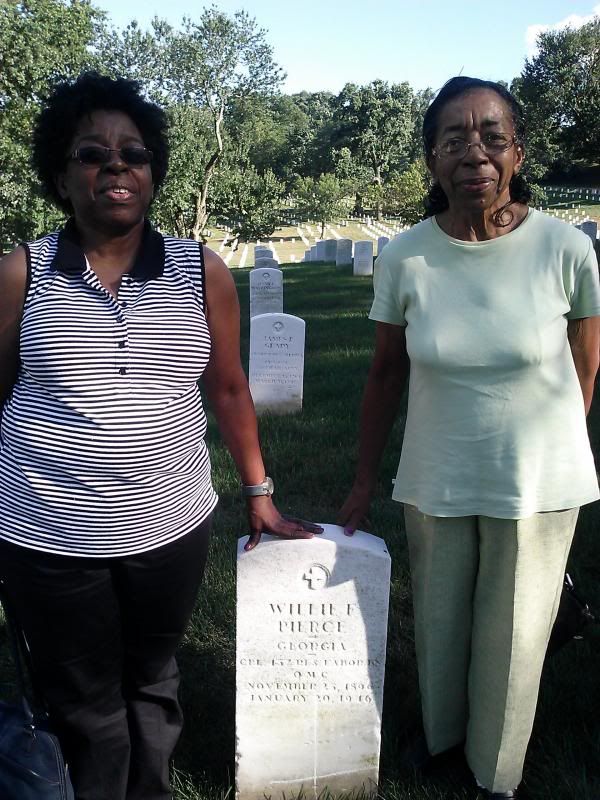
Last year, I finally found my Grand Uncle, Willie Felton Pierce,  whom I had been searching for for nearly two years. I was able to get picture of his tombstone via Find A Grave. At that time, I mentioned that I was hoping to visit my Grand Uncle's grave in person, when I attended the Pierce Descendants family reunion. I was especially thrilled that my mother was able to see her uncle's grave. As she mentioned a few times while we were there, she had been to Arlington National Cemetery in her younger days and had no clue that her uncle was interred there.


While at the family reunion, I also learned a bit more about Uncle Felton's life from one of his other nieces (my mother's first cousin), Daisy. Cousin Daisy informed me that Uncle Felton lived with their family (Grand Aunt Ossie) for awhile in Washington, DC. Cousin Daisy state that Uncle Felton returned to GA. After returning to GA,  he got sick and  decided to return to the DC area, where he remained until his death.

And with this new revelation about Uncle Felton, I learned a few more valuable research lessons this year. 

1) Be sure and talk to as many of the family elders as you can. I know this is a basic rule but I often still fail to do it thinking that they don't have anything to new contribute. Each one may be able to only provide a snippet but you know what, a bunch a snippets can sometimes make a whole.

2) Don't just fire questions at them. Cousin Daisy told me about Uncle Felton not be me interviewing her but in just general conversation. I had mentioned to her that mom and I would be visiting Uncle Felton's grave on the way home.


The picture of mom and I at Uncle Felton's grave was taken by my cousin D. Dawkins.


Friday, March 16, 2012

Are you Ready for the 1940 census?

For me the answer is a resounding NO. But hey, I've got a full 17 days to get up to speed.

In tracing my ancestors, I'm not one that really needs the 1940 census. Both of my parents had already arrived into this world by the 1930 census. So while I'm looking forward to the release of the 1940 census, it's not that critical to my research, and this could explain why I'm not ready. Well that and the fact that I've been busy with other things like what will probably be a year long house decluttering project.

Even though the 1940 census is not critical to my research efforts, there are a few things I hope to accomplish.  I'm hopeful that my Grand Uncle, Felton Pierce, will resurface, because I will not rest until I put together the rest of his life. It will also be fun to see the folks as tweens.

So, how does one prepare for the release of a new census when they only have 17 days. To be honest, I don't have a clue or a game plan, so I'll be winging it. Hopefully, I will have time within the next 17 days to post how I'm preparing myself for the release of the census.

So are you ready for the release of the 1940 census and what do you hope to accomplish?

Monday, January 30, 2012

Madness Monday


Revisiting Ancestral Neighborhoods, Cluster Research, and Continuing the Hunt for a Slave Owner

Back in 2010,  I wrote about why I thought Jesse Pierce was the last slave owner of my 2nd great grandparents, Jasper and Jane Pierce (Part IPart II). All I needed was the documentation / evidence to support my hypothesis.

In trying to regroup and revise my strategy for determining the last slave owner of my Pierce ancestors, one the first things I decided to do was revisit both the 1870 and 1880 census with a fresh set of eyes as well as mindset. I also decided to set up a spreadsheet containing information from both censuses in order to better visualize and evaluate each neighborhood on it’s own as well as in comparison to the other, highlighting the names of persons that appeared on both censuses.

When I performed that initial cursory look, I declared that many of the names were the same between the two censuses, especially the African Americans surrounding Jesse Pierce / Pearce. However, as I really looked at both censuses it appears that my cursory assessment might have been a bit off track.

1870
County:
Greene


Enumeration District:


Inhabitants In:
Militia District 144

Post Office
Penfield


Page 90


Head of Households


Name
Age
Race
Sex


Alex Mumford
42
W
M
Jackson Mumford
60
B
M
Thomas Criddle
28
B
M
Joshua Laurence
23
B
M
William Coleman
39
W
M
Wyley Bryant
35
B
M
Elijah Anderson
27
B
M
Jas Bruce
24
W
M
Siney Criddle
76
W
F
Jesse Pearce
64
W
M
Lucinda Fig
46
W
F
King Pearce
58
B
M
Jefferson Pearce
21
B
M
Bird Pearce
26
M
M
Chas Pearce
34
B
M
Alfred Pearce
28
B
M
Anderson Jones
22
B
M
Mason Jones
60
B
M
Alonzo Pearce
18
B
M
Seaborn Pearce
34
B
M
Delila Pearce
27
B
F
Aggie Jasel
20
B
F
Theopelus Pearce
63
W
M
Seaborn Jordon
50
W
M
Daniel Grant
56
W
M
John Grant
44
W
M
Archibald Rhodes
55
W
M


1880
County:
Greene


Enumeration District:
35


Inhabitants In:
144 DC G.M.


Page 252


Head of Households


Name
Age
Race
Sex


Thomas Newsome
50
W
M
Archibald Mapp
31
W
M
Kato Lewis
60
B
M
Nilson Lewis
80
B
M
Archibold P Peek
42
W
M
Jesse F. Pierce
74
W
M
James Figs
26
W
M
Siberenie Pierce
45
W (B)
B
Martha Jackson
42
B
F
Miles Pierce
46
B
M
Jasper Pierce
30
Mu
M
Greene Pierce
48
B
M
King Pierce
69
B
M
Charles Pierce
44
Mu
M
Joseph Chester
22
B
M
Patsey Lundy
16
B
F
Henry Moore
48
B
M
Joseph S Anderson
27
W
M
Elisha Irby
65
W
M
Josiah Caldwell
74
W
M
Robbert Philips
21
W
M
George Moland
21
B
M
James Alfred
55
B
M


On the 1870 Census, there are 8 African-American enumerations for Pierce / Pearce households surrounding Jesse Pearce / Pierce. The 1880 Census contains five such enumerations, one of which is my 2nd great grandfather, Jasper Pierce.

After looking closer at both censuses, it appears three families of African American Pierces appear on both census, that of King Pierce / Pearce; Chas / Charles Pierce; amd Seaborn / Siberenie Pearce / Pierce. It should be noted that on the 1880 census Seaborn / Siebernie is indicated as being white but the other information, age, contained on the census leads me to believe that this is the same person.

My question is where did the other families from the 1870 census go and where did the new families on the 1880 census come from?

As I continue the hunt to try to determine the last slave owner of my Pierce ancestors, I will try to answer these questions and hope that it leads to some breakthrough answers.

*****

To find out more about cluster research, I recommend reading some of Michael Hait's articles on this research technique.